Time that remains by the shore
Istanbul, the act of looking, and different durations within one frame, through photographs of Yeniköy, Harem, Aşiyan and Kadıköy.
- Place
- Yeniköy, Istanbul
- Photographed on
- 2025-01-01
Photography and the city — 07
Which of a city’s times remains in a photograph? Looking at Istanbul from the shore, as the times of water, light and passers-by mingle.
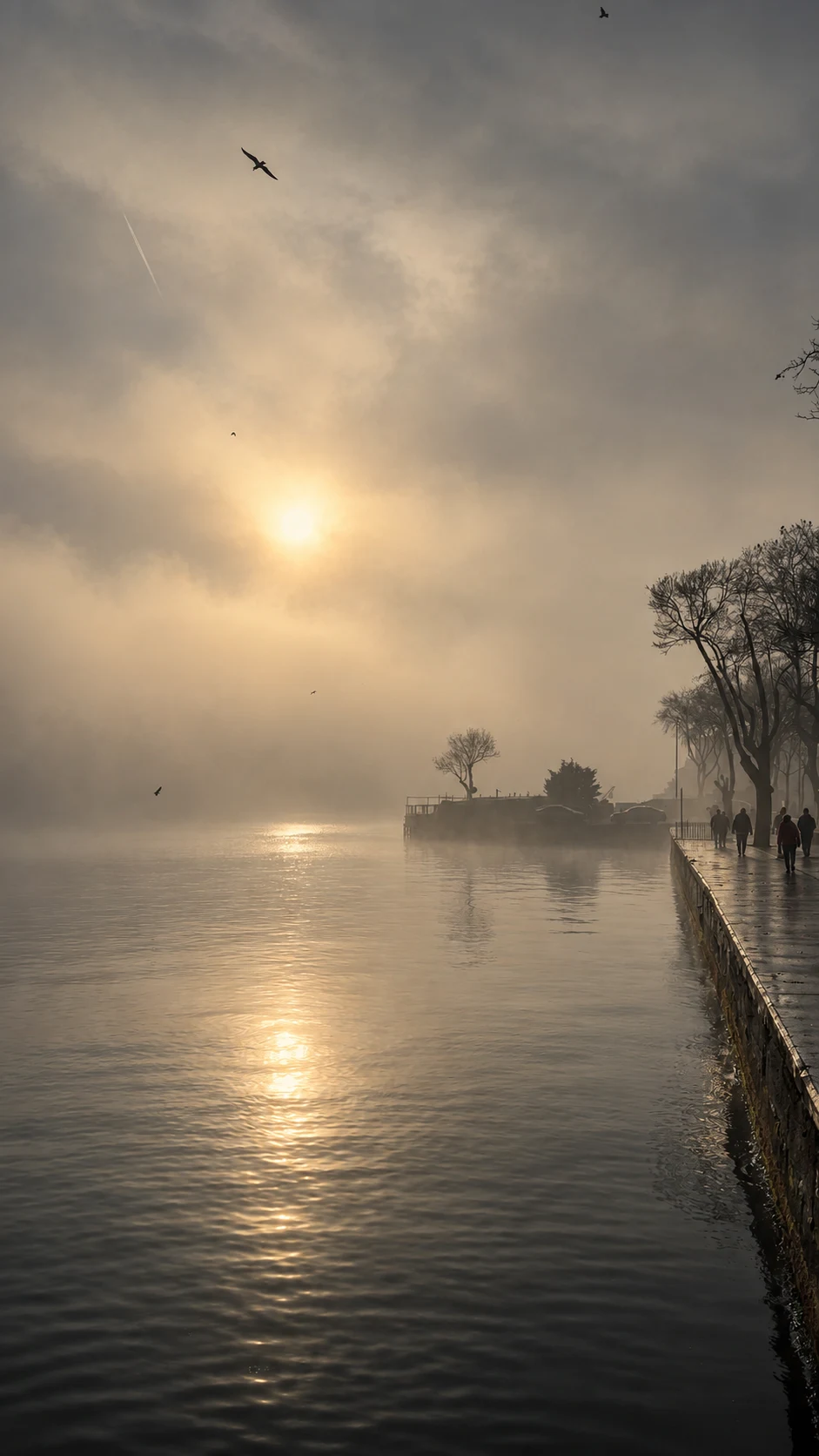
A photograph taken on the Yeniköy waterfront. Its caption gives the date as 1 January. The sun appears through the mist as a pale circle; a long trace of light lies on the water. A few people walking along the shore, bare trees, and a path growing indistinct.
A new year has begun on the calendar. Little in the photograph announces that beginning. People walk, light falls on water, the shore stretches on.
Whenever I return to this photograph, I find myself considering the distance between the date and the image. A date separates one day decisively from another. The image’s boundaries are more permeable. The mist might seem left over from the previous day; the light might belong to a day that has yet to begin.
Inside a photograph, time does not advance as regularly as it does on a calendar.
New Year’s Morning on the Yeniköy Waterfront · Yeniköy, Istanbul · 1 January 2025. Opening photograph.
There is much for the eye to hold on to when watching Istanbul from the shore. A building, a boat, lights on the opposite bank. But as the gaze lingers, the changes between them begin to appear too.
In my night photograph taken from Harem, the opposite shore emerges from darkness as a line of light. A thin mist close to the water blurs the lower edges of the buildings. Reflections break apart as they stretch downwards.
Two lights standing close together across the water can move apart in their reflections. An order I can make out along the shore dissolves on the surface.
My eye keeps travelling between these two planes. The city and its counterpart in the water take different forms within the same frame.
Perhaps this is part of why I like spending time by the shore. The image retains the feeling that it might change if I keep looking.
Lights on the opposite shore and their reflections, seen from Harem at night.
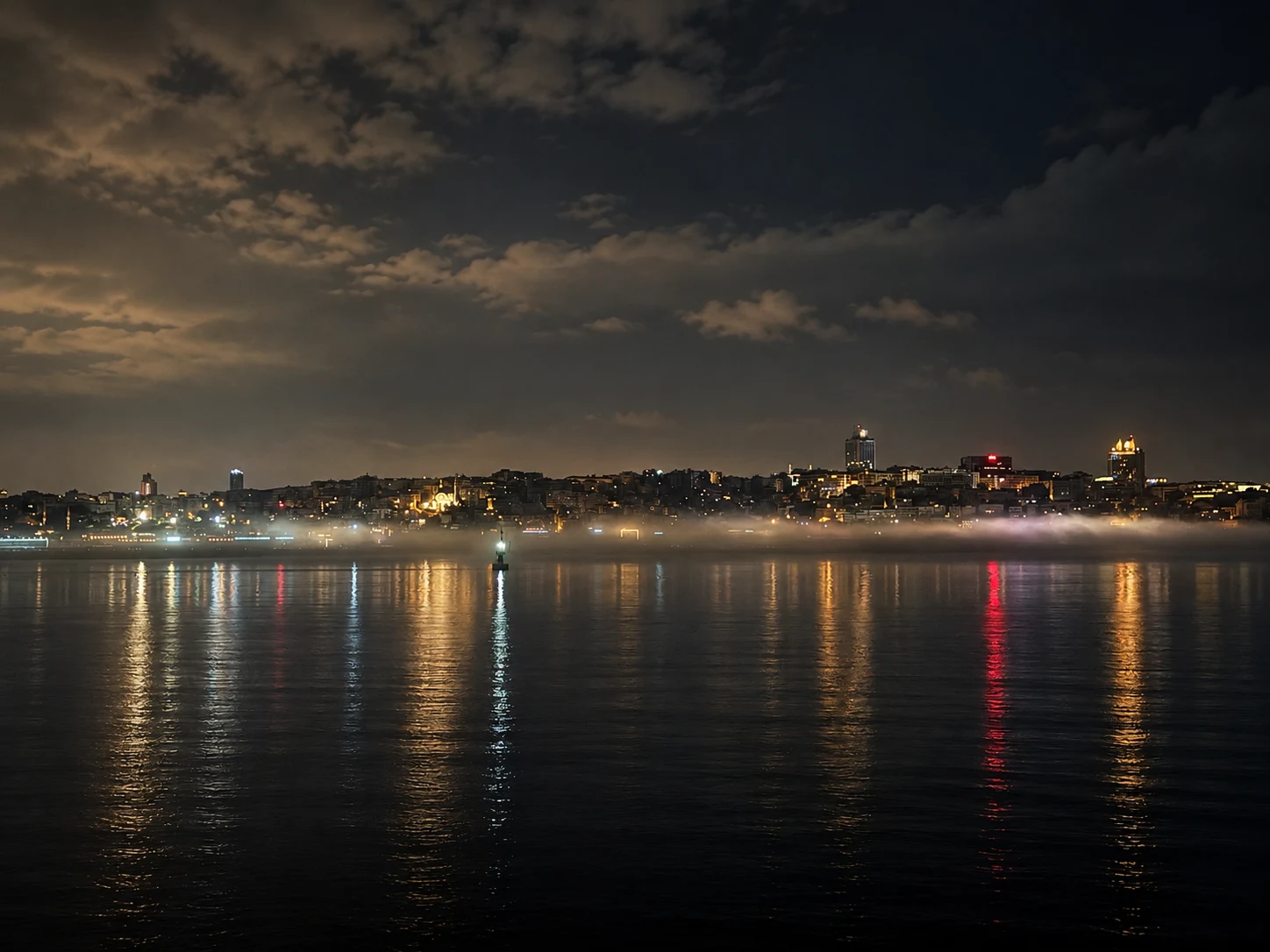
Night and Mist from Harem · Harem, Üsküdar · 3 August 2026.
In the Aşiyan photograph, warm light falls on wet stones. In the foreground, a person with their back to the camera bends towards a suitcase. Behind them are the line of the shore, a boat, lamps and the distant bridge.
It would be easy to build a story around this image. Someone hurrying somewhere, returning from somewhere, waiting…
But the photograph does not tell us which of these is true.
I see the suitcase. I see the bent body, the dark clothing, the reflections on the stones. I do not know where this person was a little earlier or where they will go next.
That absence gives me a responsibility as I look. I try not to fill the person’s life with a story that suits my own feelings. Sometimes we need to see a posture and stay with it without assuming we know its whole meaning.
Alongside the city, photographs of Istanbul contain people about whom we know very little.
A person seen from behind bending towards a suitcase on the wet Aşiyan waterfront.
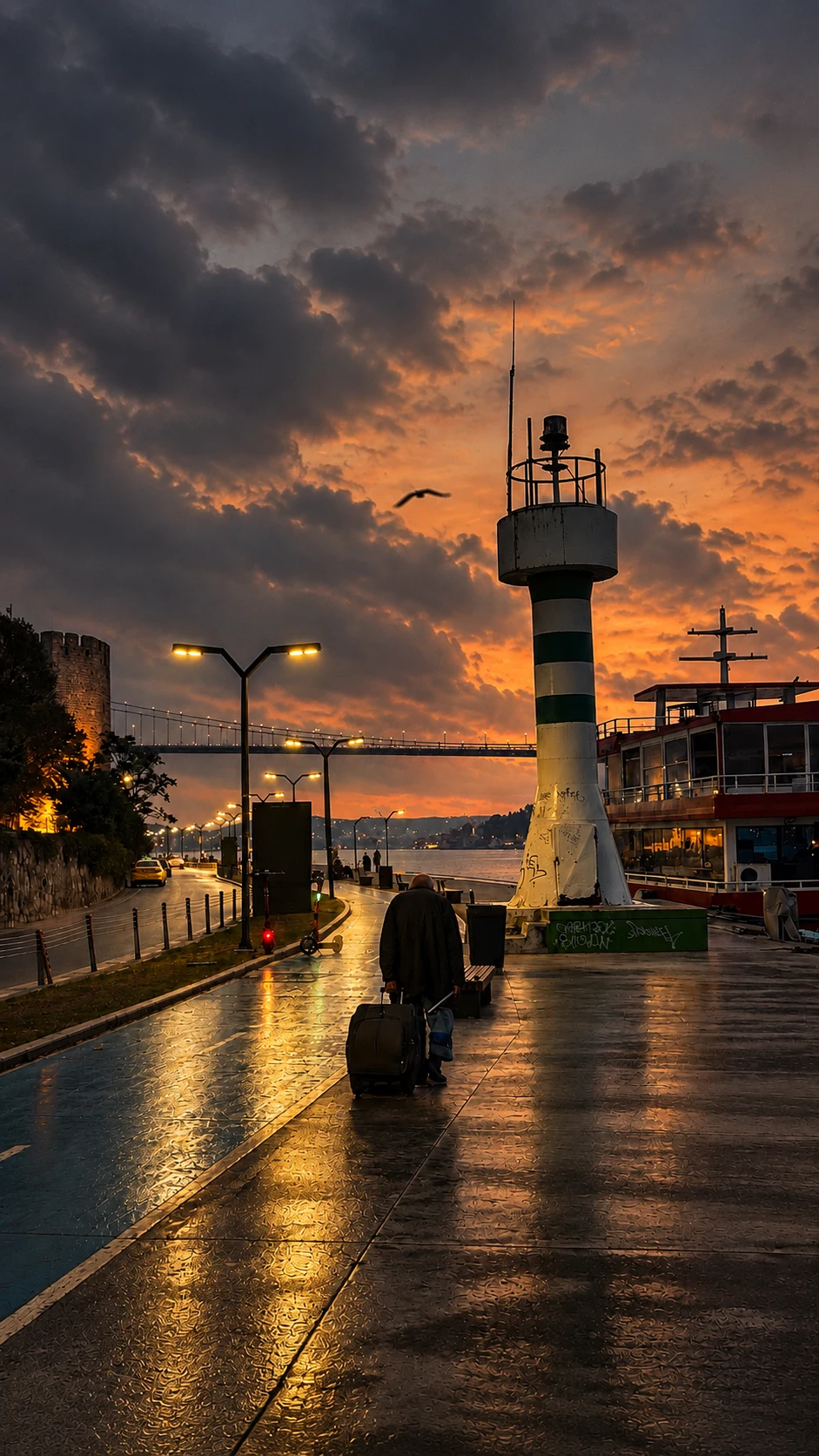
A Lone Traveller at the Harbour after Morning Rain · Aşiyan, Istanbul · 30 August 2026.
A cat lies in the foreground of another photograph I took at sunset in Kadıköy. The stone surface, rocks and dark leaves of a tree entering from the left are close by. A ferry is offshore. The orange of the sky thins in places across the water.
My gaze may go first to the sky. Then to the ferry, before returning to the cat in the foreground. A small detail in the frame makes me look at the whole view again.
Each thing held together in this photograph suggests a different duration: the ferry’s passage, the fading light, the wearing of stone, the uncertain time the cat will remain there.
So many different durations can fit inside a single instant.
Things that met on one surface when I took the photograph separate again as I look. Being able to move between them keeps bringing me back to the image.
A cat on a stone ledge on the Kadıköy shore, with a ferry offshore in orange evening light.
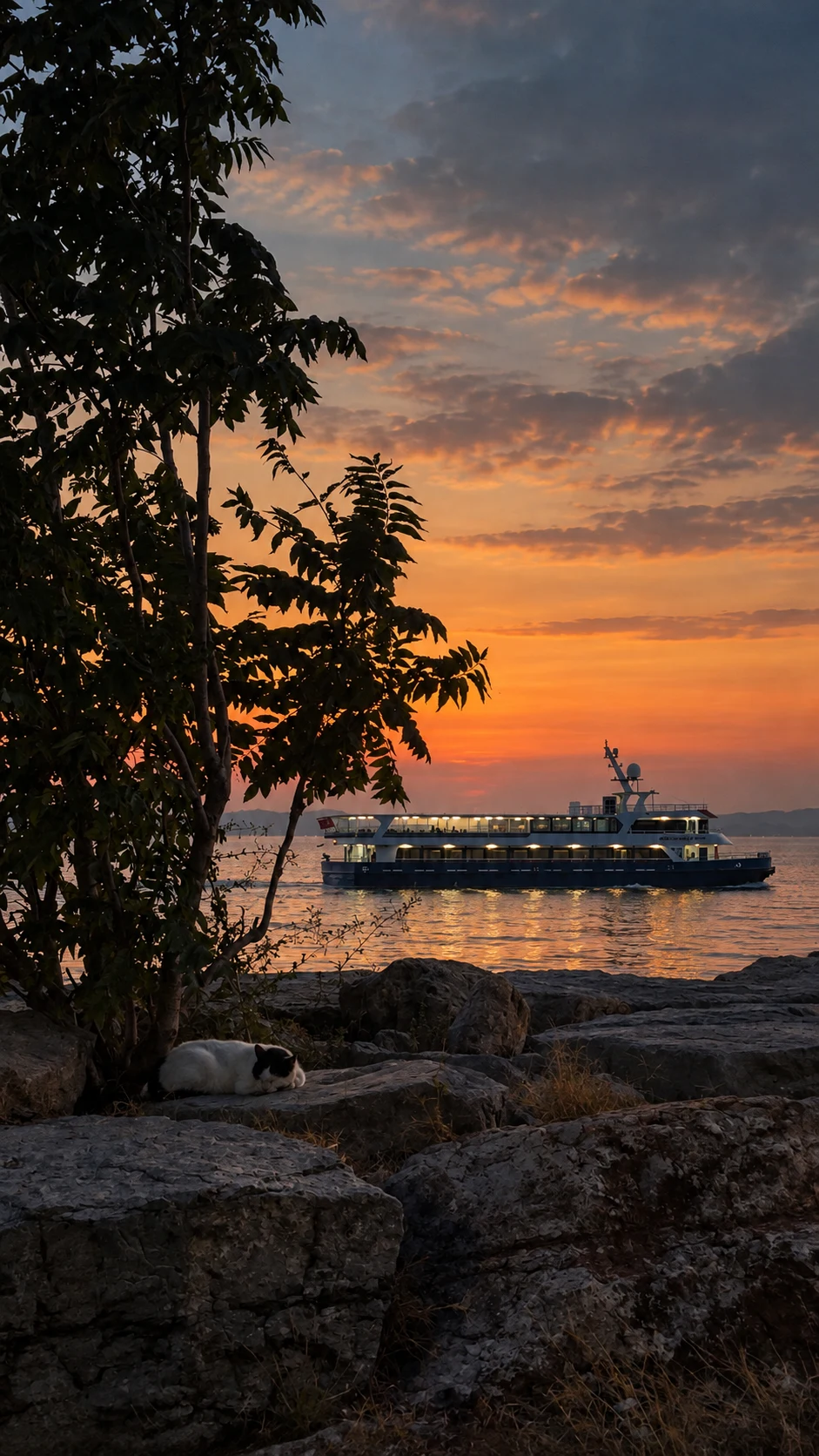
Kadıköy at Sunset · Kadıköy, Istanbul · 28 August 2026.
Putting the photographs side by side does not produce a whole that tells all of Istanbul. There is a misty morning, a wet shore, lights falling on water at night, a cat resting on stone.
I know a large city lies outside each frame. A city continuing with its noise, labour, congestion and daily rush.
These images hold small spaces where the gaze can linger for a while. I think their affinity comes from there. Though taken in different places and on different days, they approach light, distance and the edge of visibility with a similar attention.
As the archive grows, I can trace that attention too. Which views I chose, where I stood, what I left at the edge of the frame.
A way of looking at a city gradually finds a place within us.
Returning to a photograph later, I cannot recover its moment completely. The image remains, but the day on which I look at it changes. I may notice a shadow I missed before, or pass over a detail I once studied at length.
Today I might look longer at the people walking in Yeniköy. Another day, Harem’s lights might hold my attention. Opening the Kadıköy photograph to see the cat, I might find my eye caught by the stone’s surface instead.
Some of the time that remains by the shore accumulates in these returns.
I open the Yeniköy photograph again. Its caption still says 1 January. The sun is in the mist, a few people are on the path. This time my gaze stays a little longer on the thin line where water meets shore.
Photographs: Ömer Asım. Places and dates follow the archive captions. AI was used only for colour adjustment.
Shore and Sea series · Previous essay: What do we preserve when translating a song?
This connects to
Moves from meaning preserved in translation to time and viewpoint remaining in a photograph.
Reads the Yeniköy, Harem, Aşiyan and Kadıköy photographs from this series.
Revisits the previous essay’s four shore photographs through decisions about selection and sequencing.